If modern street skateboarding has a single inventor, it is Rodney Mullen. Born John Rodney Mullen on August 17, 1966, in Gainesville, Florida, he created nearly every foundational flatground trick that skaters use today — the flatground ollie, the kickflip, the heelflip, the impossible, and dozens more. Without Mullen, the vocabulary of street skating simply would not exist.
Early Life and Freestyle Dominance
Mullen started skating at age 10, after convincing his reluctant father to let him try. Within four years, he won his first world freestyle championship. Over the next decade, he won 34 out of 35 freestyle contests — the most dominant competitive run in skateboarding history.
Freestyle skateboarding in the early 1980s meant performing tricks on flat ground, usually in a choreographed routine. Mullen was not just winning; he was inventing the tricks everyone else would try to learn.
The Tricks That Changed Everything
Mullen's invention list reads like a skateboarding dictionary:
- Flatground Ollie (1982): Adapting Alan Gelfand's vert ollie to flat ground. This single trick made every other street trick possible — you cannot kickflip, grind, or gap without first being able to ollie.
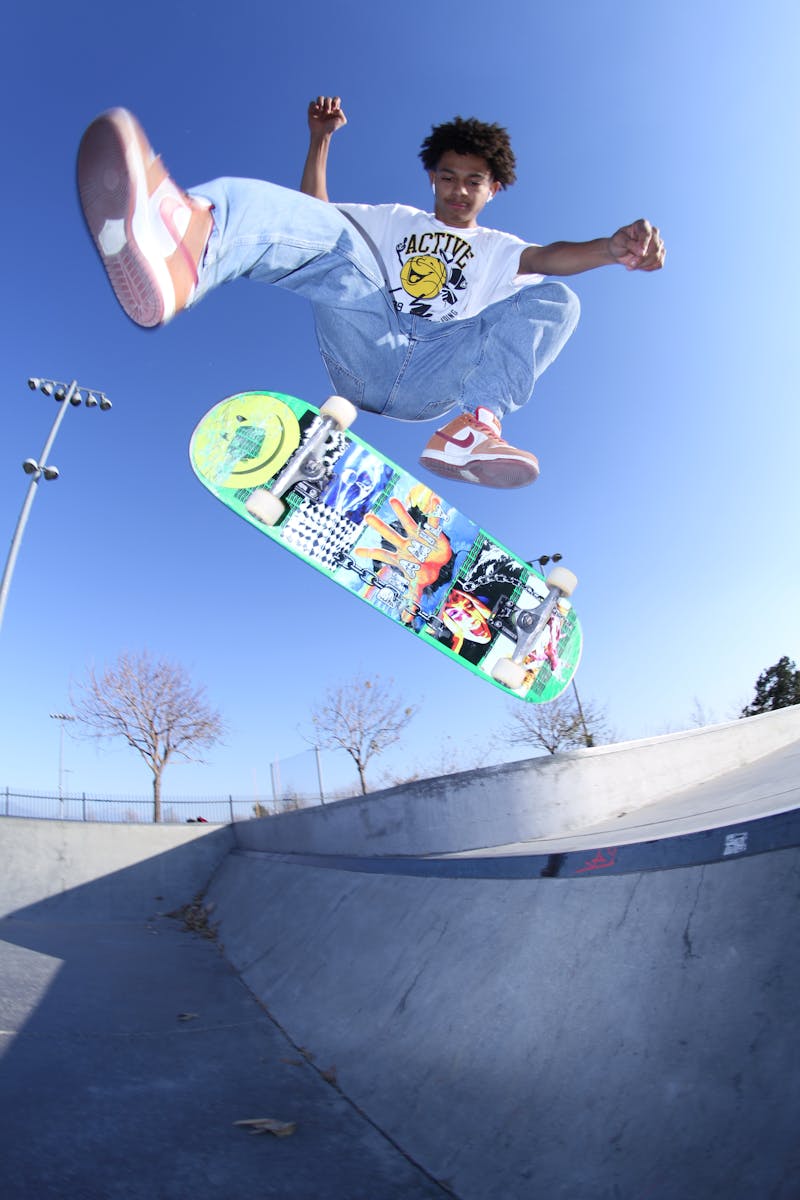
- Kickflip (1982): Originally called the "magic flip." The skater flicks the board with their front foot, causing it to flip along its length. This became the most fundamental trick in street skating.
- Heelflip (1982): The opposite of a kickflip — flicking with the heel instead of the toe. Together with the kickflip, it forms the basis of all flip tricks.
- Impossible (1982): The board wraps vertically around the back foot. A trick so strange it seemed, well, impossible.
- 360 Flip (Tre Flip): A combination of a kickflip and a 360 pop shove-it. One of the most aesthetically satisfying tricks in skating.
- Darkslide: Grinding on the grip tape side of the board. A trick so difficult that few skaters can do it consistently even today.
The Transition to Street
When freestyle skateboarding died commercially in the early 1990s, Mullen faced a crisis. His entire identity was built on a discipline that no longer had an audience. Rather than retire, he reinvented himself — taking his flatground mastery and applying it to street skating.
The transition was not easy. Street skating required a different stance, different timing, and a willingness to skate obstacles instead of flat ground. But Mullen's technical precision translated perfectly. Within a few years, he was producing video parts that redefined what was possible on a skateboard.
Key Video Parts
- Plan B — Questionable (1992): Mullen's first major street part. Showed the skating world that a freestyle skater could dominate street.
- Plan B — Virtual Reality (1993): Pushed technical skating even further. Included tricks no one had seen before.
- Almost — Round 3 (2004): The legendary "Rodney vs Daewon" series. Mullen's part included darkslides, primo slides, and combinations that defied physics.
- Globe — Opinion (2006): A raw, personal part filmed largely in parking lots. Proved that Mullen could still innovate decades into his career.
Beyond Skating
Mullen is also known for his intellectual curiosity. He has given TED talks about creativity and innovation, drawing parallels between skateboarding progression and problem-solving in other fields. He co-founded Almost Skateboards with Daewon Song and has been involved in skateboard technology development, including experimental deck construction.
Legacy
Every time a skater pops an ollie on flat ground, lands a kickflip, or flips into a grind, they are using tricks Rodney Mullen invented. His influence is so foundational that it is invisible — like the inventor of the alphabet, his work is so deeply embedded in the culture that people forget someone had to create it.
Mullen remains active in skateboarding, continuing to develop new tricks and techniques well into his fifties. His career spans over four decades, making him not just the most inventive skater of all time, but also one of the most enduring.
Watch flatground and technical street skating on sk8dreams to see Mullen's legacy in action — every flip trick on this platform traces its lineage back to a teenager in Florida who decided to make a skateboard do things no one thought possible.