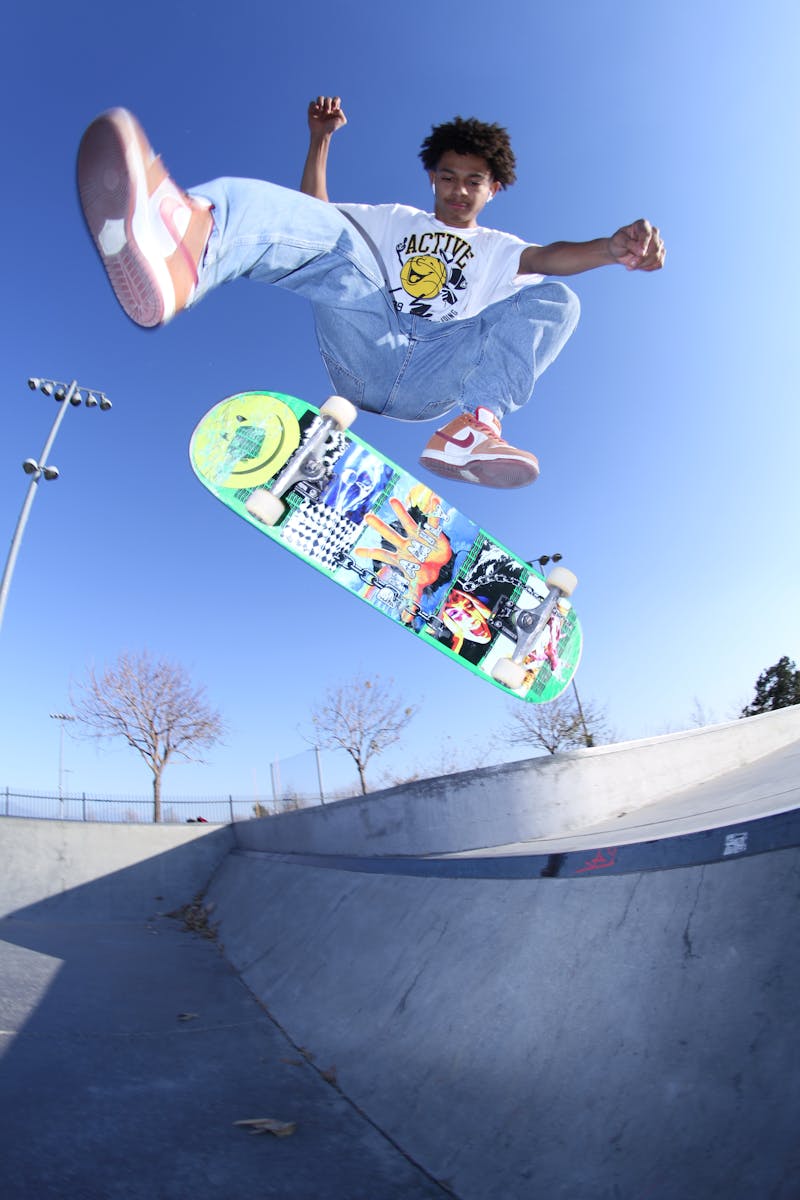
Every skateboarder follows a progression path. Some tricks must be learned before others — not because of arbitrary rules, but because each trick teaches body mechanics and board control that make the next trick possible. Here are the ten tricks every skater should learn, in the order that makes the most sense for steady progression.
1. The Ollie
The ollie is the foundation of all modern skateboarding. Invented by Alan Gelfand for vert skating and adapted to flat ground by Rodney Mullen, the ollie is how you get airborne without using your hands.
How it works: Snap the tail of the board against the ground with your back foot while simultaneously sliding your front foot up toward the nose. The friction of your shoe against the grip tape drags the board into the air. Timing is everything — the pop and the slide must happen in sequence, not simultaneously.
Why it matters: Without an ollie, you cannot kickflip, grind, or jump over or onto anything. It is the prerequisite for everything on this list.
2. Frontside 180
The frontside 180 combines an ollie with a half-rotation of your body and board. You turn to face forward (frontside) while in the air.
How it works: Wind your shoulders before you pop, then unwind as you ollie. Your body leads the rotation; the board follows. Land rolling backward (fakie) and either ride away or pivot back to normal stance.
Why it matters: It teaches you to commit to rotation, which is essential for more advanced tricks like 360 flips and bigspins.
3. Pop Shove-It
In a pop shove-it, the board rotates 180 degrees under your feet (like a backside shove) while your body stays facing forward.
How it works: Scoop the tail backward with your back foot as you pop. The board spins horizontally beneath you. Your front foot guides the catch. Keep your shoulders parallel to the direction of travel.
Why it matters: It introduces the concept of the board rotating independently from your body — a fundamental mechanic for all shove-it variations and tre flips.
4. Kickflip
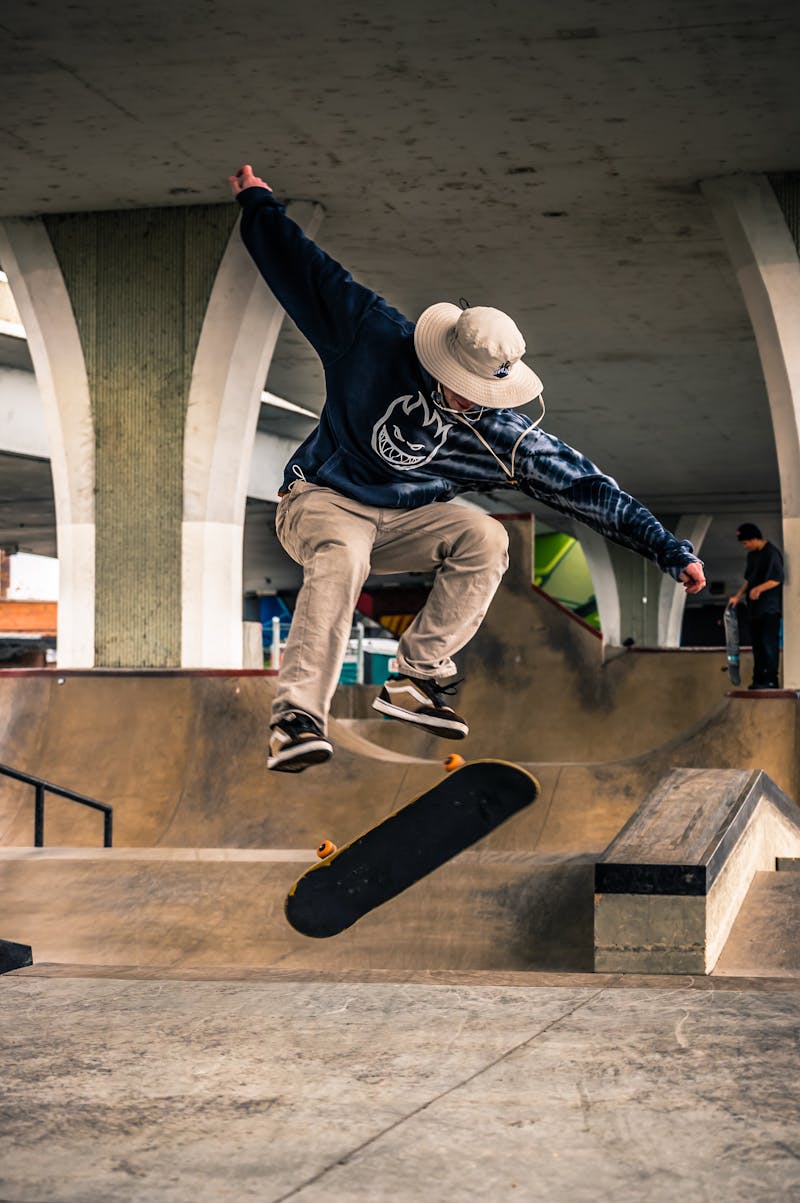
The kickflip is the defining trick of street skateboarding. The board flips along its length (the long axis) while you are in the air.
How it works: Ollie, but instead of sliding your front foot straight up, flick it off the heel-side edge of the nose. This flick causes the board to flip. Let it complete one rotation, catch it with your feet, and land.
Why it matters: The kickflip is the gateway to all flip tricks — double flips, varial flips, hardflips, and every combination thereof. Landing your first kickflip is a milestone every skater remembers.
5. Heelflip
The heelflip is the kickflip's mirror image. The board flips in the opposite direction, initiated by the heel instead of the toes.
How it works: Ollie and extend your front foot forward and slightly off the toe-side edge of the nose. Your heel catches the edge and flips the board. The rotation is opposite to a kickflip.
Why it matters: Having both kickflips and heelflips gives you a complete flip trick vocabulary. Some tricks feel more natural as heelflip variations, and learning both helps you understand board control from both sides.
6. Boardslide
The boardslide is your introduction to grinding obstacles. You ollie onto a rail or ledge and slide with the board perpendicular to the obstacle, the rail passing under the middle of your deck.
How it works: Approach the obstacle at a slight angle. Ollie, turn 90 degrees, and land with the rail or ledge under the center of your board. Slide across, then turn off at the end.
Why it matters: Boardslides teach you to commit to obstacles — overcoming the fear of jumping onto a rail is a psychological barrier as much as a physical one.
7. 50-50 Grind
The 50-50 is the most fundamental grind. Both trucks lock onto the edge of a ledge or rail, and you grind across.
How it works: Ollie onto the obstacle and land with both trucks on the edge. Keep your weight centered and ride the grind. Pop off or ride off the end.
Why it matters: It teaches you how trucks interact with obstacles — the feel of locking in, balancing on an edge, and dismounting cleanly.
8. Backside 180
The backside 180 is a half-rotation where you turn with your back leading (turning blind). It is generally considered harder than the frontside 180 because you cannot see where you are going mid-rotation.
How it works: Similar to the frontside 180 but rotating in the opposite direction. Your shoulders initiate the turn, and you land rolling fakie.
Why it matters: Backside rotation is essential for backside flips, backside bigspins, and many transition tricks.
9. Varial Kickflip
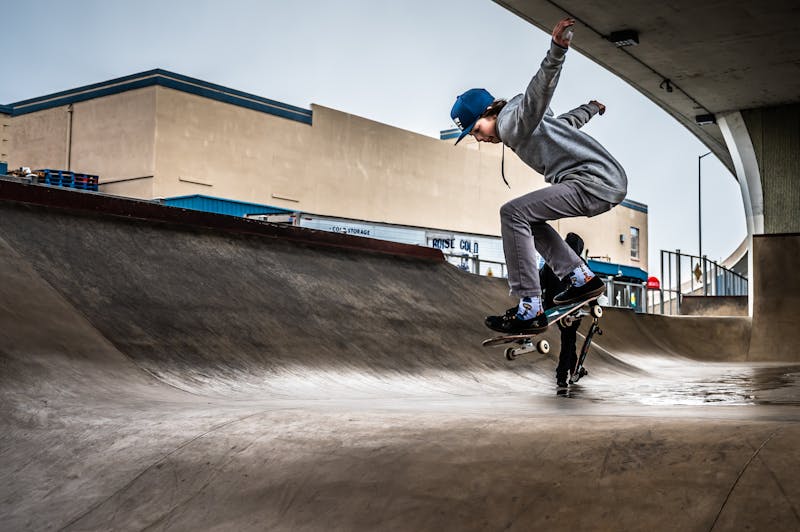
The varial kickflip combines a kickflip with a pop shove-it — the board flips and rotates 180 degrees simultaneously.
How it works: Pop a shove-it while flicking a kickflip. The board does both motions at once. Catch and land. The timing is tricky because you are combining two independent motions.
Why it matters: It is the first "combination trick" most skaters learn, and it teaches you how to blend flip and shove-it motions — the foundation of tre flips and hardflips.
10. Tre Flip (360 Flip)
The tre flip is the holy grail of intermediate skateboarding. The board does a full 360-degree rotation (shove-it) combined with a kickflip. When done well, it is one of the most beautiful tricks in skateboarding.
How it works: Scoop the tail hard (like a 360 shove-it) while simultaneously flicking a kickflip. The board spins and flips beneath you. Catch it after one complete flip and one full rotation. The scoop needs more force than a varial flip because the board must rotate a full 360 degrees.
Why it matters: The tre flip represents the combination of everything you have learned — pop, flick, scoop, catch, and commitment. Landing a clean tre flip is a sign that you have solid fundamentals and are ready for advanced street skating.
The Path Forward
These ten tricks are not the end of skateboarding — they are the beginning. Once you have them, the possibilities branch into hundreds of variations: switch stance, nollie, fakie, different grinds, different obstacles, and combinations limited only by your creativity. The key is patience. Every trick on this list took the best skaters in the world hundreds or thousands of attempts to learn.
Watch how professionals execute these tricks on sk8dreams — studying footage is one of the most effective ways to understand timing, foot placement, and style.